Hello,
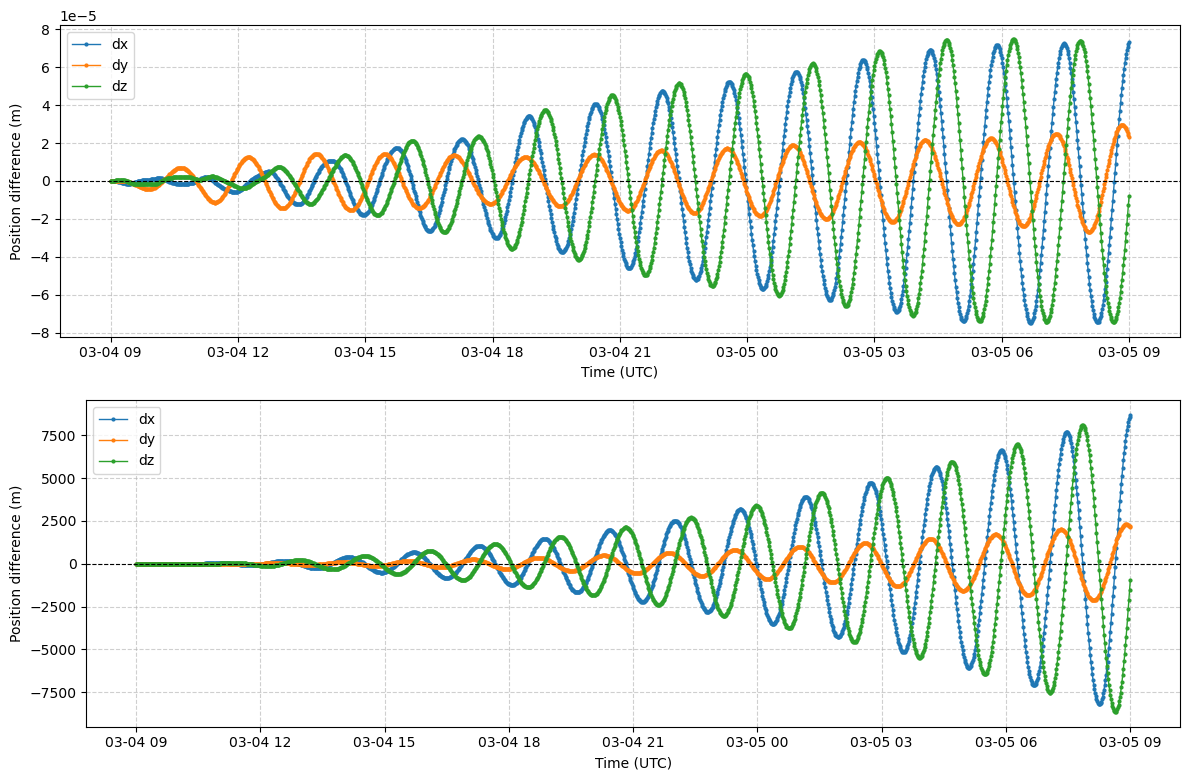
I’ve just started using the Orekit Python Wrapper to build a propagator for satellite orbits. I’m using STK to compare and match the specifications of the forces in the model, but solar radiation pressure I haven’t been able to tackle. It adds periodic differences with a max of 7500 meters after 24 hours while STK adds about 10-12 meters. Making Cr=0 or reducing the area_srp does nothing to change the effect. Making the mass of the satellite 1kg instead of 1000kg does make a difference. I have concluded that it has something to do with how i set up my force model, the code for which is below. I use RK4 in both propagators.
I’m new to this, thank you in advance.
from org.orekit.time import TimeScalesFactory, AbsoluteDate
from org.orekit.frames import FramesFactory
from org.orekit.bodies import CelestialBodyFactory
from org.orekit.utils import Constants as orekit_constants, IERSConventions

utc = TimeScalesFactory.getUTC()
epoch = AbsoluteDate(2025, 3, 4, 9, 0, 0.0, utc)  # start time of measurements (taken from file name)
ecef = FramesFactory.getITRF(IERSConventions.IERS_2010, True)
gcrf = FramesFactory.getGCRF()

mu = orekit_constants.EGM96_EARTH_MU

from org.orekit.propagation.conversion import ClassicalRungeKuttaIntegratorBuilder
from org.orekit.propagation.numerical import NumericalPropagator
from org.orekit.propagation import SpacecraftState
from org.orekit.orbits import OrbitType

sigma_position = 10
# sigma_velocity = 0.1 # m/s

# estimator parameters
estimator_position_scale = 1.0 # m

# orbit propagator parameters
prop_min_step = 0.1 # s
prop_max_step = 60.0 # s
prop_position_error = 10.0 # m

# integrator/propagator builder
integrator_builder = ClassicalRungeKuttaIntegratorBuilder(prop_max_step)
integrator = integrator_builder.buildIntegrator(ic, OrbitType.CARTESIAN)

propagator = NumericalPropagator(integrator)
propagator.setOrbitType(OrbitType.CARTESIAN)

satellite_mass = 1000.0 #can be set explicitly
initial_state = SpacecraftState(ic, satellite_mass)
propagator.setInitialState(initial_state)

# setup force model

from org.orekit.forces.gravity import ThirdBodyAttraction, HolmesFeatherstoneAttractionModel
from org.orekit.forces.gravity.potential import GravityFieldFactory
from org.orekit.forces.radiation import SolarRadiationPressure, IsotropicRadiationSingleCoefficient
from org.orekit.models.earth.atmosphere.data import CssiSpaceWeatherData
from org.orekit.bodies import OneAxisEllipsoid
from org.orekit.utils import Constants, IERSConventions

# Earth geopotential model
earth_frame = FramesFactory.getITRF(IERSConventions.IERS_2010, True)
earth_shape = OneAxisEllipsoid(Constants.WGS84_EARTH_EQUATORIAL_RADIUS,
                               Constants.WGS84_EARTH_FLATTENING,
                               earth_frame)

# Gravity field
gravity_provider = GravityFieldFactory.getNormalizedProvider(21, 21)
propagator.addForceModel(
    HolmesFeatherstoneAttractionModel(earth_frame, gravity_provider)
)

# Third bodies
sun = CelestialBodyFactory.getSun()
moon = CelestialBodyFactory.getMoon()
propagator.addForceModel(ThirdBodyAttraction(sun))
propagator.addForceModel(ThirdBodyAttraction(moon))

# Drag Force
from org.orekit.models.earth.atmosphere import NRLMSISE00, PythonNRLMSISE00InputParameters
from org.orekit.forces.drag import DragForce, IsotropicDrag

class ConstantSolarActivity(PythonNRLMSISE00InputParameters):
    def __init__(self, f10, f10_avg, ap):
        super(ConstantSolarActivity, self).__init__()
        self.f10 = float(f10)
        self.f10_avg = float(f10_avg)
        self.ap = float(ap)

    def getMinDate(self):
        return AbsoluteDate.PAST_INFINITY

    def getMaxDate(self):
        return AbsoluteDate.FUTURE_INFINITY

    def getDailyFlux(self, date):
        return self.f10

    def getAverageFlux(self, date):
        return self.f10_avg

    def getAp(self, date):

        return [self.ap] * 7

f10 = 150.0
f10_avg = 150.0
ap = 15.0

solar_params = ConstantSolarActivity(f10, f10_avg, ap)
atm = NRLMSISE00(solar_params, sun, earth_shape)

cross_section = 8.5194   # m^2 (given that orekit sets a default mass of 1000kg, this corresponds to a 0.0085194 m^2/kg area/mass ratio))
drag_coef = 2.2

iso_drag = IsotropicDrag(cross_section, drag_coef)
drag_force = DragForce(atm, iso_drag)
propagator.addForceModel(drag_force)

# Solar Radiation Pressure
cr = 1.2
area_srp = 8.5194 # m^2 (corresponds to 0.0085194 m^2/kg area/mass ratio with default mass)
srp_model = IsotropicRadiationSingleCoefficient(area_srp, cr)
srp = SolarRadiationPressure(sun, earth_shape, srp_model) # (uses the Earth as occulting body and a dual cone shadow model)

propagator.addForceModel(srp)