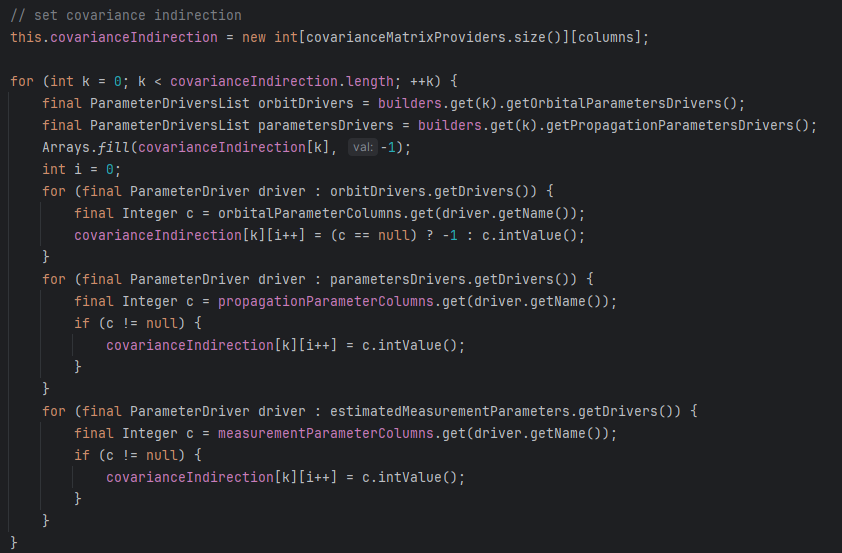
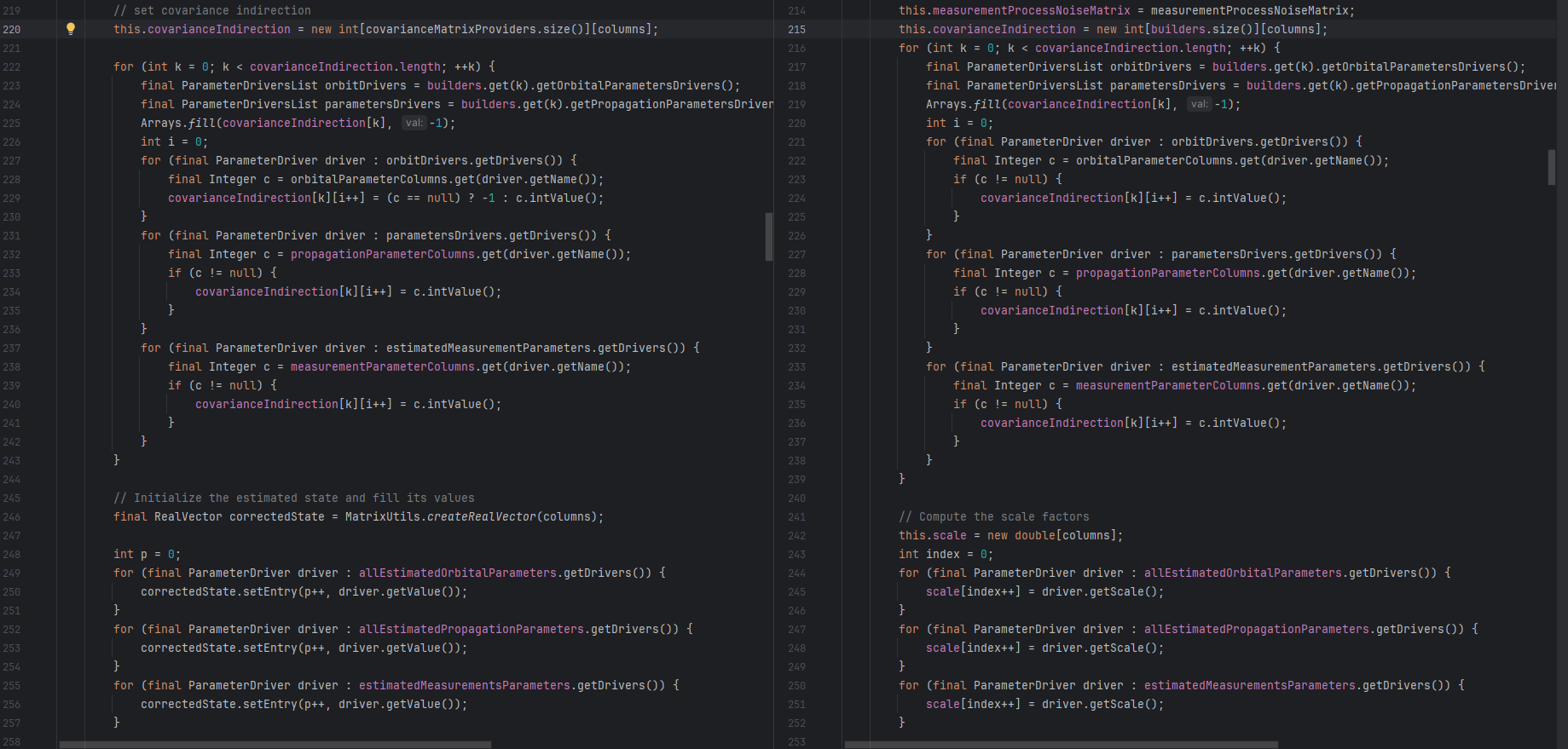
Hi @bcazabonne, I am running into this same error when building an EKF using a Numerical Propagator.
My EKF class looks like this:
class ExtendedKalmanFilter(
    private val propagatorBuilder: PropagatorBuilder,
    private val station: GroundStation,
    private val frame: Frame,
    private val noiseModel: NoiseModel
) {
    private lateinit var kalmanEstimator: KalmanEstimator

fun initializeKalmanEstimator() {
        val choleskyDecomposer = CholeskyDecomposer(1E-12, 1E-12)
        val initialCovariance = DiagonalMatrix(doubleArrayOf(10000.0, 10000.0, 10000.0, 1.0, 1.0, 1.0))
        val initialProcessNoise = DiagonalMatrix(doubleArrayOf(1e-10, 1e-10, 1e-10, 1e-10, 1e-10, 1e-10))

        val builder = KalmanEstimatorBuilder()
        builder.addPropagationConfiguration(propagatorBuilder(), ConstantProcessNoise(initialCovariance, initialProcessNoise))
        builder.decomposer(choleskyDecomposer)

        kalmanEstimator = builder.build()
    }

    private fun propagatorBuilder() = propagatorBuilder

    fun estimate(measurement: AngularRaDec) {
        val estimatedPropagators = kalmanEstimator.estimationStep(measurement)
    }

    fun getEstimatedState(): RealVector {
        return kalmanEstimator.physicalEstimatedState
    }

    fun getEstimatedCovariance(): RealMatrix {
        return kalmanEstimator.physicalEstimatedCovarianceMatrix
    }
}
This error occurs when I call kalmanEstimator = builder.build() in my initialization. How do I resolve this issue?
I have created the following tests and when I run testKalmanInitialization, I run into the error. I am unsure what other parameters need to be defined. I thought it may have something to do with the “drivers” or the normalized parameters but my understanding of both of these is lacking for sure.
class ExtendedKalmanFilterTest {
    private lateinit var ekf: ExtendedKalmanFilter
    private lateinit var propagatorBuilder: PropagatorBuilder
    private lateinit var groundStation: GroundStation
    private lateinit var frame: Frame
    private lateinit var noiseModel: NoiseModel

    companion object {
        val initialOrbit: Orbit = CartesianOrbit(
            PVCoordinates(
                Vector3D(6871.0e3, 0.0, 0.0),
                Vector3D(0.0, 7.8e3, 0.0)
            ),
            FramesFactory.getEME2000(),
            AbsoluteDate.J2000_EPOCH,
            Constants.EGM96_EARTH_MU
        )
    }

    @BeforeEach
    fun setUp() {
        val dataDirectory = File("src/main/resources/orekit-data-master.zip")
        System.setProperty(DataProvidersManager.OREKIT_DATA_PATH, dataDirectory.absolutePath)

        propagatorBuilder = NumericalPropagatorBuilder(initialOrbit)
        frame = FramesFactory.getEME2000()
        noiseModel = NoiseModel()

        val node = Node(
            id = UUID.fromString("07dab967-fefb-4671-a229-3ce22f277850"),
            name = "OurSky Node0_6b",
            location = Point(
                -77.919167,
                39.095472,
                224.9
            ),
            cameraId = UUID.fromString("dff9fc6e-97e2-4fdc-986b-ed719511a5f2"),
            createdBy = UUID.fromString("0fab28b9-fa97-4836-b0d8-f205d364bb96"),
            diagnosticsEnabled = true,
            elevationMask = null,
            minAltitude = 20,
            mountId = UUID.fromString("2306d93b-1c35-4c74-a1ca-cb140fc0b264"),
            observatoryId = null,
            opticalTubeId = UUID.fromString("3b1243a8-3272-49df-996a-c276f74cf732"),
            organizationId = UUID.fromString("140fc9e4-ea1d-4452-941f-8bda318aec0c"),
            slewTiming = null,
            state = NodeState.READY,
            createdAt = OffsetDateTime.now()
        )

        val topoFrame = topoFrameForPoint(node.location, node.name)
        groundStation = GroundStation(topoFrame)

        ekf = ExtendedKalmanFilter(propagatorBuilder, groundStation, frame, noiseModel)
        ekf.initializeKalmanEstimator()
    }

    @Test
    fun testKalmanInitialization() {
        assertDoesNotThrow { ekf.initializeKalmanEstimator() }
    }

    @Test
    fun testEstimation() {
        val initialPosition = initialOrbit.pvCoordinates.position

        val ra = FastMath.atan2(initialPosition.y, initialPosition.x)
        val dec = FastMath.atan2(initialPosition.z, FastMath.sqrt(initialPosition.x * initialPosition.x + initialPosition.y * initialPosition.y))

        val error = 5.0 * FastMath.PI / (180.0 * 3600.0) // 5 arcseconds in radians
        val raWithError = ra + error
        val decWithError = dec + error

        val date = AbsoluteDate.J2000_EPOCH.shiftedBy(1000.0)
        val sensorData = SensorData("node-1", listOf(0.1, 0.2), listOf(0.05, 0.06), hasGPSTiming = true)

        val measurementWithError = ekf.createMeasurement(date, raWithError, decWithError, sensorData, 5.0)

        assertDoesNotThrow { ekf.estimate(measurementWithError) }
    }

    @Test
    fun testGetEstimatedState() {
        assertDoesNotThrow {
            val estimatedState = ekf.getEstimatedState()
            assertNotNull(estimatedState)
        }
    }

    @Test
    fun testGetEstimatedCovariance() {
        assertDoesNotThrow {
            val covarianceMatrix = ekf.getEstimatedCovariance()
            assertNotNull(covarianceMatrix)
        }
    }
}
Another thought was that I may be building my propagator incorrectly?
class NumericalPropagatorBuilder(var initialOrbit: Orbit) : PropagatorBuilder {

    private val frame: Frame = FramesFactory.getEME2000()
    private val mu: Double = Constants.EGM96_EARTH_MU

    private val integrator: DormandPrince853Integrator
    private val numericalPropagator: NumericalPropagator

    init {
        val minStep = 0.001
        val maxStep = 500.0
        val positionError = 0.001
        val initialOrbit = initialOrbit
        val orbitType = OrbitType.CARTESIAN
        val tolerance = NumericalPropagator.tolerances(positionError, initialOrbit, orbitType)
        integrator = DormandPrince853Integrator(minStep, maxStep, tolerance[0], tolerance[1])

        numericalPropagator = NumericalPropagator(integrator)
        numericalPropagator.setMu(Constants.EGM96_EARTH_MU)
        numericalPropagator.initialState = SpacecraftState(initialOrbit)

        val gravityField = GravityFieldFactory.getNormalizedProvider(12, 12)
        val gravityForceModel = HolmesFeatherstoneAttractionModel(
            FramesFactory.getEME2000(),
            gravityField
        )
        numericalPropagator.addForceModel(gravityForceModel)
    }

    override fun buildPropagator(normalizedParameters: DoubleArray): Propagator {
        return numericalPropagator
    }

    override fun copy(): PropagatorBuilder {
        return NumericalPropagatorBuilder(initialOrbit)
    }

    override fun getFrame(): Frame {
        return frame
    }

    override fun getInitialOrbitDate(): AbsoluteDate {
        return initialOrbit.date
    }

    override fun getMu(): Double {
        return mu
    }

    override fun getOrbitalParametersDrivers(): ParameterDriversList {
        return ParameterDriversList()
    }

    override fun getOrbitType(): OrbitType {
        return OrbitType.CARTESIAN
    }

    override fun getPositionAngleType(): PositionAngleType {
        return PositionAngleType.MEAN
    }

    override fun getPropagationParametersDrivers(): ParameterDriversList {
        return ParameterDriversList()
    }

    override fun getSelectedNormalizedParameters(): DoubleArray {
        return doubleArrayOf()
    }

    override fun resetOrbit(newOrbit: Orbit) {
        this.initialOrbit = newOrbit
    }

    // dummy BLS
    override fun buildLeastSquaresModel(
        builders: Array<PropagatorBuilder>,
        measurements: MutableList<ObservedMeasurement<*>>,
        estimatedMeasurementsParameters: ParameterDriversList,
        observer: ModelObserver
    ): AbstractBatchLSModel? {
        return null
    }
}
Apologies for the very long response 8 months after the fact. Thank you in advance! Also, I am using Kotlin so that should explain the funky syntax!